

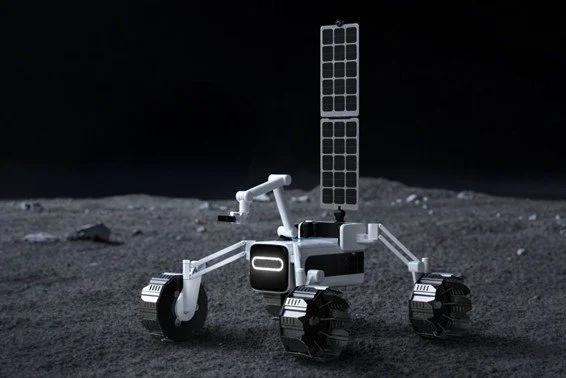
Concept drawing of the robot system to be developed in this project. A robot equipped with an electron-beam generator irradiates the lunar surface directly beneath it, conducting heating and melting experiments on regolith (lunar soil).
The technology development project “Development of Electron-Beam Regolith Solidification Technology and a Lunar Mobile Robot System,” led by Specially Appointed Professor Kazuya Yoshida of the New Industry Creation Hatchery Center (NICHe), Tohoku University (Special Advisor to the President of Tohoku University), has been selected for the JAXA Space Strategy Fund Program (Phase II): Elemental Technologies Contributing to the Construction of Lunar Infrastructure, and the grant has been officially awarded.
In recent years, exploration plans by national space agencies and private companies have advanced rapidly toward the construction of sustainable activity bases on the Moon. Future lunar activities will require infrastructure to support landing, mobility, and habitation, but one of the greatest challenges is the extremely high cost of transporting materials from Earth. To address this challenge, it is essential to establish technologies that use regolith, which is widely available on the lunar surface, as an in-situ construction material.
This project aims to demonstrate that structural materials can be produced on the Moon by melting and solidifying regolith with an electron beam, thereby establishing the core technology for directly constructing infrastructure such as landing pads and roadways on site. In addition, the project will develop a multifunctional lunar mobile robot system responsible for this construction work (see image above) and will verify construction techniques under conditions that simulate the real environment, thereby building the technological framework required for lunar base construction.
Read the full press release [in English] or [in Japanese].